Biography · Sam Altman
He writes no code and publishes no papers. Yet he carried the AGI age onto the throne — and burned himself, too, on that throne.
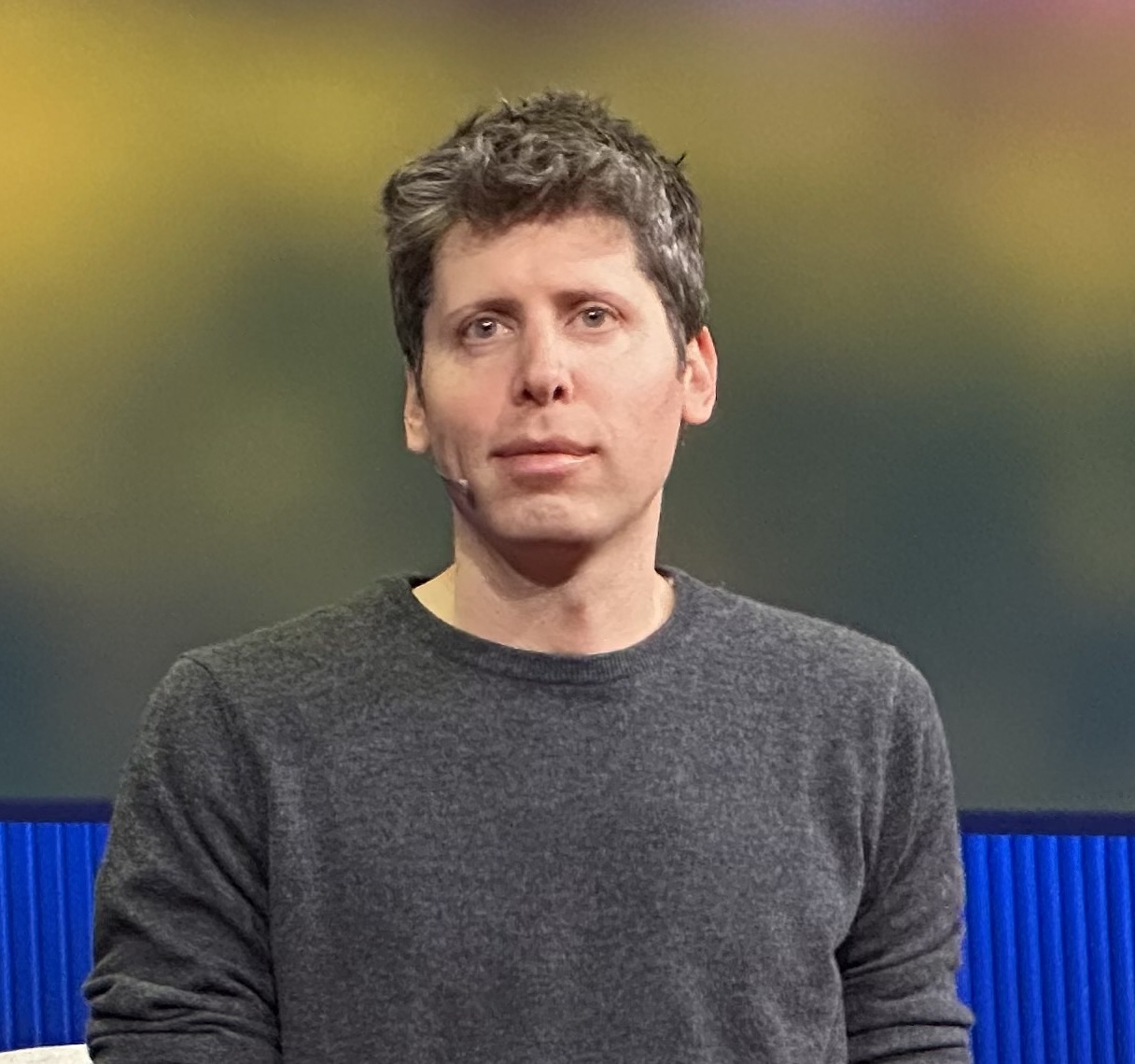
A St. Louis Boy and His First Mac
Sam Altman (1985–) — full name Samuel Harris Altman — was born in Chicago, Illinois, on 22 April 1985. A few months later the family moved to St. Louis, Missouri. His father was a real-estate developer, his mother a dermatologist. He was the eldest of four.
When he was eight he was given his first Macintosh. In countless later interviews he has returned to what that machine meant to him — "it was a door." At the John Burroughs School in Missouri he received an Apple LC II, taught himself BASIC and LOGO, and wrote small programs for classmates in exchange for pocket money. At sixteen he came out as gay before the school — the only openly gay student on campus at the time. The early willingness to break norms would run through his whole career.
In 2003 he entered Stanford to read computer science. By his second year he and two classmates had built Loopt, a location-based social-sharing app — you could see where your friends were at any moment. In 2005 he made the decision Silicon Valley would later imitate countless times: he dropped out of Stanford to make Loopt a company.
That summer Loopt joined the very first batch of Y Combinator. The cohort had only eight companies; Altman was nineteen. The man at the head, Paul Graham, would become the most important guide of his life.
Loopt, YC, and a Dynasty of Incubators
Loopt eventually raised more than 30 million US dollars and was acquired in 2012 by Green Dot for 43.4 million — by Silicon Valley standards a respectable but unspectacular exit. The greater gift was not the money but the ticket it gave Altman to Graham's inner circle.
In February 2014 Graham unexpectedly announced his retirement and handed the presidency of Y Combinator to a 28-year-old Altman. The appointment provoked scepticism: how could a serial entrepreneur with no spectacular success run America's most prestigious incubator?
Altman answered with the next several years. He grew each YC batch from a few dozen companies to more than a hundred, expanded its scope from web software to biotech, fusion, aerospace, and even cryptocurrency, extended YC's capital tools from pure angel investing into the growth fund YC Continuity, and in 2015 launched something no one then understood — a "non-profit research lab" he called OpenAI. By the time he stepped down as YC president in 2019, the cumulative valuation of YC-incubated companies had passed 150 billion dollars.
A Lab Founded with Musk
On 11 December 2015, in a meeting room in San Francisco, several papers of articles were signed. Among the eleven founders, the two most prominent were Altman and Elon Musk (1971–) — the YC president and the man steering SpaceX and Tesla. Together with Greg Brockman and Ilya Sutskever (1986–), just lured from Google Brain, they signed a charter that read almost like an oath: "To advance digital intelligence in the way that is most likely to benefit humanity as a whole, unconstrained by a need to generate financial return."
Altman put that sentence into the first line of the charter himself. He has said in many interviews that he believes the birth of AGI is the most important event of this century, and that what AGI becomes should not be decided by Google alone. He and Musk shared the largest portion of the initial billion-dollar funding pledge, and Altman became chairman.
The partnership did not last. In February 2018, Musk left after the board rejected his demand to take direct charge of OpenAI, suspending most of his unfulfilled funding. The surface was placid; beneath ran the seam of the great rupture six years later, in a California courtroom and a series of open letters. With his largest backer gone, Altman stood alone in a place no one else could fill — the non-profit model could not bear the compute bills that were coming. In March 2019 he led the design of a "capped-profit" hybrid structure, and the same year signed a 10-billion-dollar partnership with Microsoft, binding Azure as OpenAI's compute infrastructure. From that moment, OpenAI began walking a road that drifted from its founding intent.
The ChatGPT Moment
Late on the night of 30 November 2022, Altman posted a two-line tweet — OpenAI had launched a conversational product called ChatGPT, built on GPT-3.5. Inside the company, it was billed as a "low-key research preview"; there was no launch event, no advertisement. Several former employees later said they had bet that user numbers would stall in the tens of thousands by the end of the week.
Five days later, registered users passed one million. Two months later, one hundred million. It was the fastest-spreading consumer product in human history.
ChatGPT's success was not solely a technical matter. The base model, GPT-3.5, had been available via API for months; no one had yet thought to wrap it as a chat box in a browser. Altman saw it. Inside the company he kept pushing the simplest path — stop making users read documentation, stop making them write Python to call an API; let them talk to it like a human.
The next year was OpenAI in full sprint. In January 2023 Microsoft committed an additional 10 billion dollars; in March, GPT-4 was released; in the second half of the year Altman embarked on a global tour, from Brussels to Tokyo, from Tel Aviv to Seoul, discussing AI regulation with heads of state. Almost overnight he became the industry's default spokesperson.
The Five-Day Coup
At noon Pacific time on 17 November 2023, the OpenAI board issued a sudden statement: Altman had been removed as CEO because he had been "not consistently candid in his communications with the board." Brockman resigned soon afterwards. The CTO Mira Murati became interim CEO, and was replaced two days later by the former Twitch CEO Emmett Shear.
The next 72 hours were the most theatrical stretch in AI history. On 20 November, Microsoft announced it would hire Altman and Brockman to run a new division; the same day, more than 700 OpenAI employees signed an open letter demanding the board's resignation and Altman's return, threatening collective departure to Microsoft. Among the signatures was that of Ilya Sutskever (1986–) himself — who posted on X: "I deeply regret my participation in the board's actions."
Late on 21 November, an agreement was reached. Altman returned, a new board was constituted, and almost all of the directors who had fired him were swept away. The five-day crisis would later be called the "OpenAI coup." Outsiders read its roots as the line between the safety camp and the acceleration camp; what stunned the world, however, was that this 38-year-old product manager had proved in five days a single thing — the soul of OpenAI lay not in its board but in the invisible bond between him and his team.
The 852-Billion-Dollar Crown
After the coup Altman won almost everything — and began to lose some of what he had once cherished.
Across 2024 and 2025, OpenAI completed a thorough restructuring from "capped-profit" into a Public Benefit Corporation (PBC). Its valuation rose from 80 billion dollars to 500 billion, and in March 2026 a fresh round set the post-money valuation at 852 billion dollars. Annualised revenue passed 25 billion; the headcount grew to about 7,700. At the same time Sutskever left in May 2024 to found Safe Superintelligence Inc.; the co-head of safety Jan Leike departed for Anthropic, leaving behind the often-quoted line: "Safety culture and processes have taken a backseat to shiny products." Mira Murati, John Schulman, and Bob McGrew followed in turn. Of the eleven who signed the charter in 2015, by the end of 2025 only Altman, Brockman, and Wojciech Zaremba remained.
In 2024 Altman formally separated from Y Combinator, transforming wholly from an incubator mentor into the CEO of the AI age. His personal investment portfolio spans Reddit, Stripe, Worldcoin (digital identity), Helion (fusion), Retro Biosciences (longevity) — each tied to one of his publicly declared bets on what is "important for humanity's future."
In February 2024 Musk formally sued OpenAI, accusing it of betraying its non-profit founding intent. The former partners faced each other in court; Altman's only public response was: "We will keep doing what we are supposed to do." The internal emails surfaced by the suit have since become some of the most detailed primary sources in AI start-up history. In them, the Musk of 2018 had pushed OpenAI in the most strident terms toward a for-profit conversion — an irony Altman, in public, has needed only silence to underline.
Selected Milestones
| Year | Event | Significance |
|---|---|---|
| 2005 | Co-founds Loopt (first YC batch) | Begins serial entrepreneurship at 19 |
| 2014 | Becomes president of Y Combinator | Expands YC into the world's largest start-up incubator |
| 2015 | Co-founds OpenAI and serves as chairman | Lights the fuse of the AGI age with Elon Musk (1971–) and others |
| 2019 | Leads OpenAI's restructuring to capped-profit; closes 10-billion-dollar partnership with Microsoft | Gives non-profit AGI an enterprise-grade compute base |
| 2022 | Drives the launch of ChatGPT | Brings large models into every ordinary browser |
| 2023 | Returns as CEO five days after being fired | Five days proved CEO is more than a title |
| 2025 | Leads OpenAI's transformation into a Public Benefit Corporation (PBC) | Paves the way for OpenAI's eventual IPO |
| 2026 | OpenAI valued at 852 billion dollars | The fastest private company in history to that valuation |
Historian's Note
Historian's Note
The path of Altman shows the birth of a new kind of power. He writes no code, publishes no papers, holds no majority stake — yet by 2026 he has become the single most influential individual on earth over the direction of AI. That alone is the most worthy phenomenon of this generation's AI history. His gift is not in algorithms but in the capacity to bind people and resources into one rope: he can make Ilya Sutskever (1986–) believe in a mission, make Microsoft believe in returns, make employees, politicians, and ordinary users believe in him. Yet power is a double-edged blade. He took five days to defeat a palace move staged in the name of "safety," and over those same five days he drove the safety faction — the counterweight — out of OpenAI's inner circle for good. He is at once the former ally of Elon Musk (1971–) and his courtroom opponent today; he is at once the founder of the non-profit OpenAI and the executive who carried it to an 852-billion-dollar valuation. Both truths hold of him at the same time, and cannot be separated. Future readers should see clearly: he did not invent AGI, but he is the true product manager of the AGI age. When history looks back and asks who took AI out of the laboratory, the answer is, more likely than not, his name.
Eyewitness Accounts
Call for contributions
If you worked with Altman at Loopt, Y Combinator, or OpenAI, or lived through the five days of November 2023, please contribute on GitHub.
References
- Altman, S. (2015–2024). Personal blog, blog.samaltman.com, collected essays.
- OpenAI (2015). "Introducing OpenAI." OpenAI Blog, December 11, 2015.
- OpenAI (2019). "OpenAI LP." OpenAI Blog, March 11, 2019.
- OpenAI (2022). "Introducing ChatGPT." OpenAI Blog, November 30, 2022.
- Wikipedia. "Removal of Sam Altman from OpenAI." Comprehensive timeline and primary sources for the November 2023 events.
- Hao, K. (2025). Empire of AI: Dreams and Nightmares in Sam Altman's OpenAI. Penguin Press.
- Musk v. Altman et al., U.S. District Court, Northern District of California, Case No. 4:24-cv-04722 (filed August 2024).
- Friend, T. (2016). "Sam Altman's Manifest Destiny." The New Yorker, October 10, 2016.
- The New York Times (2023). "Inside the OpenAI Boardroom Drama." Continuous coverage, November 2023.
- The Atlantic (2023–2025). Karen Hao's investigative series on OpenAI.