Biography · Norbert Wiener
He gave the world the word feedback, and yet missed every human feedback that came his way.
The Cost of a Prodigy
Norbert Wiener was born in November 1894 in Columbia, Missouri. His father Leo Wiener was a Harvard professor of Slavic languages — an iron-willed linguist who decided his son would be a prodigy.
He succeeded; the price was appalling. Norbert read at three; by seven he was reading Dante and Darwin; he entered high school at nine, Tufts College at eleven; he graduated college at fourteen, and at eighteen took a Harvard PhD in mathematical logic — his thesis on the Principia Mathematica of Bertrand Russell and Alfred North Whitehead. Leo announced in public, "My son's achievements are entirely the result of my methods of education." Norbert spent his life unable to step out from beneath that sentence. In two autobiographies — Ex-Prodigy (1953) and I Am a Mathematician (1956) — he returned again and again to the wound. He acknowledged that his father had made him fast; he also acknowledged that his father had made him forever insecure, awkward, and difficult with other people.
After Harvard he travelled to Cambridge to study with Russell, then on to Göttingen to study with David Hilbert. In 1919, at twenty-four, he joined the mathematics faculty at MIT — at the time an engineering school whose academic standing trailed Harvard by some distance. He stayed there for the rest of his life.
In the Corridors of MIT
Through the 1920s and 1930s Wiener produced first-rate work in pure mathematics: the Wiener process for Brownian motion, the Tauberian theorems in generalised harmonic analysis, the Paley–Wiener integral. Yet he was never quite a contented pure mathematician. MIT was a school for engineers, and the practical problems of electrical engineers — filtering, signals, noise — kept tugging at his sleeve. Slowly he turned the razor of mathematics on the world of engineering.
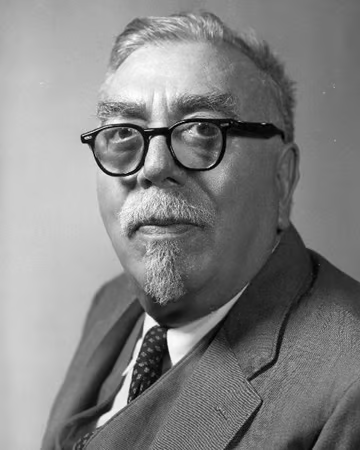
His eccentricities were legendary. Wiener was a plump, near-sighted man with a goatee and a duck-like walk. He was known to stop graduate students in the hallway and ask, "Was I walking from the cafeteria to here, or from here to the cafeteria?" — he genuinely could not remember, and needed an answer in order to deduce whether or not he was hungry.
He fell asleep in lectures and woke to point out, with surgical precision, the step where the speaker's proof had gone wrong. In writing letters of recommendation for his students he spent more lines praising himself than the candidate. This was the laziness of a genius and the compensation of a man ill at ease.
He was insecure and proud. He needed to be acknowledged. Once offended, he would erase the offender entirely from his life. This trait would, in due time, end one of his most important friendships catastrophically.
Anti-Aircraft Fire and the Birth of Feedback
By 1940 the European war was on. Wiener went to MIT's vice-president Vannevar Bush, head of the National Defense Research Committee, and offered his services. He was assigned to anti-aircraft fire control.
The problem looked simple. An aircraft crosses the sky at hundreds of kilometres an hour; an anti-aircraft shell takes several seconds to reach its target. The gunner must predict where the aircraft will be by the time the shell arrives. But the pilot is a human being who jinks; his trajectory is not a deterministic function but a stochastic process.
Wiener and his assistant Julian Bigelow turned the problem into one of statistical prediction: given past trajectory data, compute the optimal linear estimate of future position. This was the famous Wiener filter.
The deeper consequence, however, was not the filter but a realisation he had along the way. Every control system — anti-aircraft gun, neural reflex, household thermostat — is built on a single loop: measure, error, correct, measure again. This loop he named in Greek: kybernetiké, the art of the helmsman. In 1948 he Anglicised it: cybernetics.
1948: Two Books and a New World
1948 was a miracle year. Claude Shannon at Bell Labs published A Mathematical Theory of Communication. That autumn, Wiener published Cybernetics: or Control and Communication in the Animal and the Machine.
Cybernetics is not an easy book — Wiener wrote in a tangled, prolix style, dropping into French and German without translation. But its place in intellectual history is a watershed. Reflexes in the nervous system, feedback in electrical circuits, thermostats in machines, governance in society: from a sufficient height, all are the same thing. Feedback leapt overnight from an engineering term to a meta-concept that crossed biology, psychology, sociology, and artificial intelligence. Reprinted again and again in the post-war years, translated into dozens of languages, the book detonated through the intellectual world.
What is most extraordinary is the timing. In 1948 the digital computer was barely two or three years old; the term "artificial intelligence" was eight years away. Wiener foresaw it all: automatic machines would replace some human labour, adaptive learning would give rise to a new sort of "machine intelligence," society would have to come to terms with this new force. In 1950 he expanded these social reflections into a popular book, The Human Use of Human Beings: Cybernetics and Society. The title itself was a challenge — when machines can do what humans do, what is left of human use? The book is one of the foundational documents of AI ethics.
The Macy Conferences and a Catastrophic Rupture
In the first years after the war, Wiener was the spiritual centre of the cybernetic circle. From 1946 to 1953 the Macy Foundation in New York funded a series of small interdisciplinary conferences — physicians, mathematicians, psychologists, anthropologists around a single table, discussing feedback systems. Warren McCulloch, Walter Pitts, John von Neumann, and Margaret Mead were regulars. Wiener was the soul of the meetings.
But he was, famously, suspicious and easily slighted. In 1952 a rupture broke out between him and McCulloch and Pitts. The trigger remains disputed among historians: one version has it that Wiener's wife Margaret bore an intense hostility toward McCulloch and falsely told Wiener that the young men in McCulloch's group had "corrupted" their daughter; another points to MIT internal politics over funding and personnel. Whatever the cause, the outcome is fixed: Wiener never spoke to McCulloch or Pitts again, never attended another Macy meeting, never set foot inside the circle he had helped to found.
The blow to Pitts was annihilating. Pitts — who had written to Russell at fifteen, who at twenty had co-authored with McCulloch the founding paper of mathematical neural modelling — had treated Wiener as a father. To be cut off without explanation by him drove Pitts into depression and alcoholism. He burned his unfinished doctoral dissertation, drifted out of academic life, and in 1969 died alone, sick, and poor.
Cybernetics as a movement lost its centre of gravity. When the Dartmouth Workshop reconvened the field in 1956 under the name "artificial intelligence," Wiener's name was not on the invitation list. John McCarthy later said openly that he had deliberately avoided the word cybernetics because that circle had become "impossible to work with." A change of vocabulary marked a change of generation: cybernetics exited; artificial intelligence entered.
Late Years and Legacy
After 1956 Wiener increasingly resembled both a prophet and an exile. He publicly refused to take any military funding; in 1947 he published "A Scientist Rebels" in The Atlantic, openly questioning whether scientists had the right to hand their results to the military; he wrote autobiographies, novels, gave lectures across the country, warning that automation would devour the middle class.
On 18 March 1964, while visiting Stockholm, Wiener died of a heart attack at sixty-nine. Earlier that year President Johnson had presented him with the National Medal of Science. At the White House ceremony he could barely speak, choked up like a schoolboy — for all his lifelong arrogance, this lonely mathematician still cared, very deeply, about being recognised.
His tragedy was this: he spent his life studying feedback and knew that the stability of every control system depends on the error signal being correctly received. His own ability to receive human feedback was disastrous. The feedback with his father was a one-way command; with friends, allergic suspicion; with his age, lonely prophecy. The founder of cybernetics lost control of his own life's loop.
Selected Works
| Year | Work | Significance |
|---|---|---|
| 1942 | "Extrapolation, Interpolation, and Smoothing of Stationary Time Series" (classified report; published 1949) | The Wiener filter, foundation of modern statistical prediction |
| 1943 | "Behavior, Purpose and Teleology" (with Rosenblueth and Bigelow) | First redefinition of "purpose" via feedback; herald of cybernetics |
| 1948 | Cybernetics: or Control and Communication in the Animal and the Machine | Founded cybernetics; raised feedback to a meta-disciplinary concept |
| 1950 | The Human Use of Human Beings | Foundational work of AI ethics and technology criticism |
| 1953 / 1956 | Ex-Prodigy / I Am a Mathematician (autobiographies) | Honest reckoning with a prodigy's childhood, witness to an age |
Historian's Note
Historian's Note
With a precociously matured brain Wiener entered mathematical logic, Brownian motion, harmonic analysis, filter theory, cybernetics, and ethical critique — and in each of these places he established something new. But his nature was suspicious, quick to anger, and unable to forgive. In old age he severed himself from his closest collaborators, broke up the Macy circle he had helped to build, and indirectly drove Pitts to ruin; the cybernetic line was thereafter eclipsed by the new army at Dartmouth. Feedback is the doctrine of listening to one's own error and correcting course. Wiener could write the law of feedback for machines, and could not build the loop for himself — bitter irony. And yet his learning was vast, his thought deep, his concern for the world early and prescient: he stood not below Turing or Shannon. Whoever today speaks of AI safety, of automation's social shock, of the ethics of "machines replacing humans," must trace the lineage to this old man. No one writing on automata can fail to acknowledge him as origin.
Eyewitness Accounts
Call for contributions
If you knew Norbert Wiener personally or have firsthand sources or recollections, please contribute on GitHub.
References
- Wiener, N. (1948). Cybernetics: or Control and Communication in the Animal and the Machine. Cambridge: MIT Press.
- Wiener, N. (1950). The Human Use of Human Beings: Cybernetics and Society. Boston: Houghton Mifflin.
- Wiener, N. (1949). Extrapolation, Interpolation, and Smoothing of Stationary Time Series. Cambridge: MIT Press.
- Rosenblueth, A., Wiener, N., & Bigelow, J. (1943). "Behavior, Purpose and Teleology." Philosophy of Science, 10(1), 18–24.
- Wiener, N. (1953). Ex-Prodigy: My Childhood and Youth. New York: Simon & Schuster.
- Wiener, N. (1956). I Am a Mathematician: The Later Life of a Prodigy. Garden City: Doubleday.
- Conway, F., & Siegelman, J. (2005). Dark Hero of the Information Age: In Search of Norbert Wiener, the Father of Cybernetics. New York: Basic Books.
- Heims, S. J. (1980). John von Neumann and Norbert Wiener: From Mathematics to the Technologies of Life and Death. Cambridge: MIT Press.
- Smalheiser, N. R. (2000). "Walter Pitts." Perspectives in Biology and Medicine, 43(2), 217–226.