Biography · Alan Turing
He asked the world: can machines think? The world would not let him live as himself.
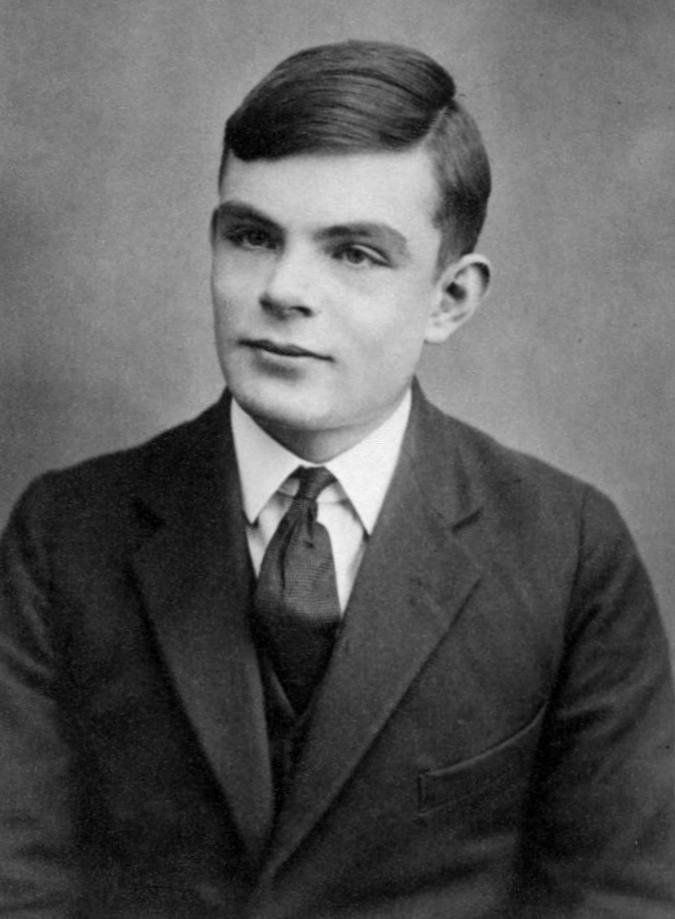
One Man and One Question
Cambridge, 1935. A twenty-three-year-old runs along the banks of the River Cam. He runs fast — fast enough that he would later be considered for Britain's Olympic marathon team — but his mind moves faster still. What troubles him is a problem left behind by a German mathematician: David Hilbert's Entscheidungsproblem. Is there a universal mechanical procedure that can decide the truth or falsity of any mathematical proposition?
The whole world of mathematical logic is asking this question. Across the Atlantic, Alonzo Church has answered in the negative using his lambda calculus. But Alan Turing has not yet seen Church's result. He is thinking in his own way — not from symbolic logic, but from the simple fact of a person sitting at a desk, pencil in hand, calculating.
The legend places the eureka moment in the meadows of Grantchester. After his run, Turing lies in the grass, looking up at the sky, and a picture forms in his mind: an infinite paper tape, a read-write head, a finite set of state rules. That is all. No gears, no circuits, no need for the thing to actually exist. It is a machine that lives purely in thought.
In 1936 he wrote the idea down as "On Computable Numbers, with an Application to the Entscheidungsproblem." The paper accomplished something that had never been done before: it precisely defined computation itself. Before Turing, people knew how to compute; they could not say what computation was. The Turing machine not only fixed the meaning of "computable," it drew an inviolable boundary — there exist questions no mechanical procedure can ever answer. That boundary still stands. Every computer on Earth today, from the server farms of the great data centers to the phone in your pocket, is in theory nothing more than a physical embodiment of that paper-tape machine.
Turing was twenty-four.
Codes and Silence at War
In 1939 the war broke out. Turing was summoned to Bletchley Park, Britain's most secret cryptographic centre. His adversary was the Enigma machine of Nazi Germany — an enciphering device whose astronomical combinatorics had convinced the German military it could not be broken.
At Bletchley, Turing was famous for his eccentricities. He chained his tea mug to the radiator so no one could take it. In hay-fever season he cycled to work wearing a gas mask. The chain on his bicycle was faulty: every so many revolutions of the pedals it would slip off, and rather than have it repaired Turing counted the revolutions exactly and dismounted just before it failed. This habit of reducing everything to a calculable problem was the very form of his genius.
He designed the electromechanical machine called the Bombe, which exploited the relation between known plaintext and ciphertext to dramatically narrow the search space for the daily Enigma key. Each day, as fresh intercepts piled on the cryptanalysts' desks, countless lives hung on whether the team could find the day's key within twenty-four hours. Historians estimate that the work at Bletchley shortened the European war by at least two years and saved millions of lives.
But Turing could claim none of this in public. The Official Secrets Act sealed everything. For decades after the war his colleagues were forbidden from speaking of what they had done. The world knew Turing only as a mathematician; it did not know that he had also been a silent hero of the war.
"I Propose to Consider the Question, 'Can Machines Think?'"
After the war, Turing designed the Automatic Computing Engine (ACE) at the National Physical Laboratory, then helped build the Manchester Mark I at the University of Manchester. But what kept him awake at night was not how to build a faster computer, but a far more fundamental question.
In 1950 he published a paper in the philosophical journal Mind whose opening sentence read: "I propose to consider the question, 'Can machines think?'"
It was an astonishing rhetorical choice. Turing could easily have written a technical paper bristling with mathematical logic. He did not. He chose instead to begin with a game — the "imitation game": let a human judge converse, by text only, with both a person and a machine. If the judge cannot reliably tell which is which, then we have no good reason to deny the machine intelligence.
What made the move so deft? It side-stepped "consciousness," "soul," and "subjective experience" — concepts that philosophy will never settle — and brought the question down to operational, observable ground. Turing did not ask what a machine is; he asked only what it does. This was not evasion but a deep philosophical position: if behaviours are indistinguishable, insistence on a hidden distinction is mere prejudice.
In the same paper he answered, with rare patience, nine separate objections — from the theological ("thinking is the work of the soul") to the mathematical (the limits posed by Gödel's incompleteness theorems), from "machines cannot be conscious" to "machines lack originality." He even foreshadowed the basic strategy of machine learning: rather than try to programme an adult mind directly, programme a child mind and let it learn through education and experience.
"Computing Machinery and Intelligence" remains one of the most cited papers in the field of artificial intelligence. More than seventy years on, as large language models make it harder and harder, in more and more settings, to tell whether one is conversing with a person or a program, we are forced to admit: Turing's question has not aged. It is more urgent than ever.
From Computation to Life
What surprised many was the violent turn Turing's research took in the last years of his life — away from abstract computation and toward concrete biology. He began to study morphogenesis: the spots on a leopard, the spirals on a seashell, the petal counts of flowers — the patterns that crowd nature. How do they arise spontaneously from a uniform soup of chemicals?
His 1952 paper "The Chemical Basis of Morphogenesis" introduced the reaction–diffusion equation and showed that two chemicals diffusing and reacting at different rates could generate stable spatial patterns out of homogeneous initial conditions. The model was experimentally vindicated only decades after his death; it has since become a cornerstone of mathematical biology.
This was not the hobby of a mathematician dabbling. It was a deeper question: if computation is the manipulation of symbols, what is life? Turing was using the language of mathematics to rethink how the material world grows complex order from simple rules. Had he lived another twenty years, the history of computational biology might have been written differently.
Destruction
In January 1952 Turing's house was burgled. He reported it to the police. In the course of their investigation, the police discovered that Turing was having a sexual relationship with a young man. Under the British law of the day, homosexuality was a criminal offence. Turing was arrested, prosecuted, and convicted.
He was offered a choice: prison, or chemical castration. He chose the latter — a year-long course of oestrogen injections to suppress his libido. The "treatment" produced humiliating bodily changes, including breast development, and his mental state deteriorated rapidly. His security clearance was revoked; he could no longer work for the government on cryptographic problems. The man who had helped his country win the war was now being punished by the same country as a criminal.
On 7 June 1954, Turing was found dead in his bedroom. On the bedside table lay a half-eaten apple. The coroner recorded death by cyanide poisoning and ruled the death a suicide. He was forty-one.
About the apple, much has been speculated. Some say it had been laced with cyanide. Others say Turing had a habit of eating an apple before bed, and that this particular apple was never tested. Some see a tribute to Snow White — Turing's favourite fairy tale, the poisoned-apple scene in particular having long fascinated him. Still others say that a man who had spent his life asking what is decidable left, with his last act, an undecidable problem for the world.
Justice, Late
In 2009, after a petition signed by more than thirty thousand people, Prime Minister Gordon Brown issued a public apology on behalf of the British government, calling Turing's treatment "appalling." In 2013 Queen Elizabeth II signed a Royal Pardon. In 2017 the Alan Turing Law took effect, retroactively pardoning all those convicted under historical anti-homosexuality statutes. In 2021 Turing's portrait was printed on the British fifty-pound note — a country honouring, in the most ordinary way it knew, the genius it had once destroyed.
The highest prize in computer science, the Turing Award, has been given in his name since 1966. It is widely called the Nobel of computing.
Selected Works
| Year | Work | Significance |
|---|---|---|
| 1936 | "On Computable Numbers, with an Application to the Entscheidungsproblem" | Defined the Turing machine and the boundary of computability |
| 1939–1945 | Bletchley Park codebreaking work (declassified after the war) | Broke Enigma, shortening WWII by at least two years |
| 1950 | "Computing Machinery and Intelligence," Mind, 59(236) | Introduced the Turing test and the question "Can machines think?" |
| 1952 | "The Chemical Basis of Morphogenesis," Phil. Trans. R. Soc. B | Founded mathematical biology; explained spontaneous pattern formation |
Historian's Note
Historian's Note
With a machine that did not exist Turing defined the boundary of computation; with a game that did not exist he laid bare the question of intelligence; with a modest set of equations he revealed how life grows order out of chaos. His thought ranged across mathematics, engineering, philosophy, and biology, leaving in each a permanent mark. And yet this man, who opened doors for civilisation, was devoured by civilisation's own prejudice. He asked whether machines could think, while the society around him could not even answer whether a man might be permitted to live as himself. A society that destroys its own genius does not deserve the future that genius creates. History has pardoned Turing; it cannot return the four decades it took from him. Symbols on a tape may be erased and rewritten. A human life cannot.
Eyewitness Accounts
Call for contributions
If you knew Alan Turing personally or have firsthand sources or recollections, please contribute on GitHub.
References
- Turing, A. M. (1936). "On Computable Numbers, with an Application to the Entscheidungsproblem." Proceedings of the London Mathematical Society, 2(42), 230–265.
- Turing, A. M. (1950). "Computing Machinery and Intelligence." Mind, 59(236), 433–460.
- Turing, A. M. (1952). "The Chemical Basis of Morphogenesis." Philosophical Transactions of the Royal Society of London. Series B, 237(641), 37–72.
- Hodges, Andrew (1983). Alan Turing: The Enigma. London: Burnett Books.
- Copeland, B. Jack (2004). The Essential Turing. Oxford: Oxford University Press.
- Singh, Simon (1999). The Code Book. London: Fourth Estate.
- Leavitt, David (2006). The Man Who Knew Too Much: Alan Turing and the Invention of the Computer. New York: W. W. Norton.