Biography · Herbert A. Simon
A single man stretched across the Turing Award and the Nobel Prize in Economics. He pulled the question of how we think from the clouds of philosophy down to the plain table of computation.
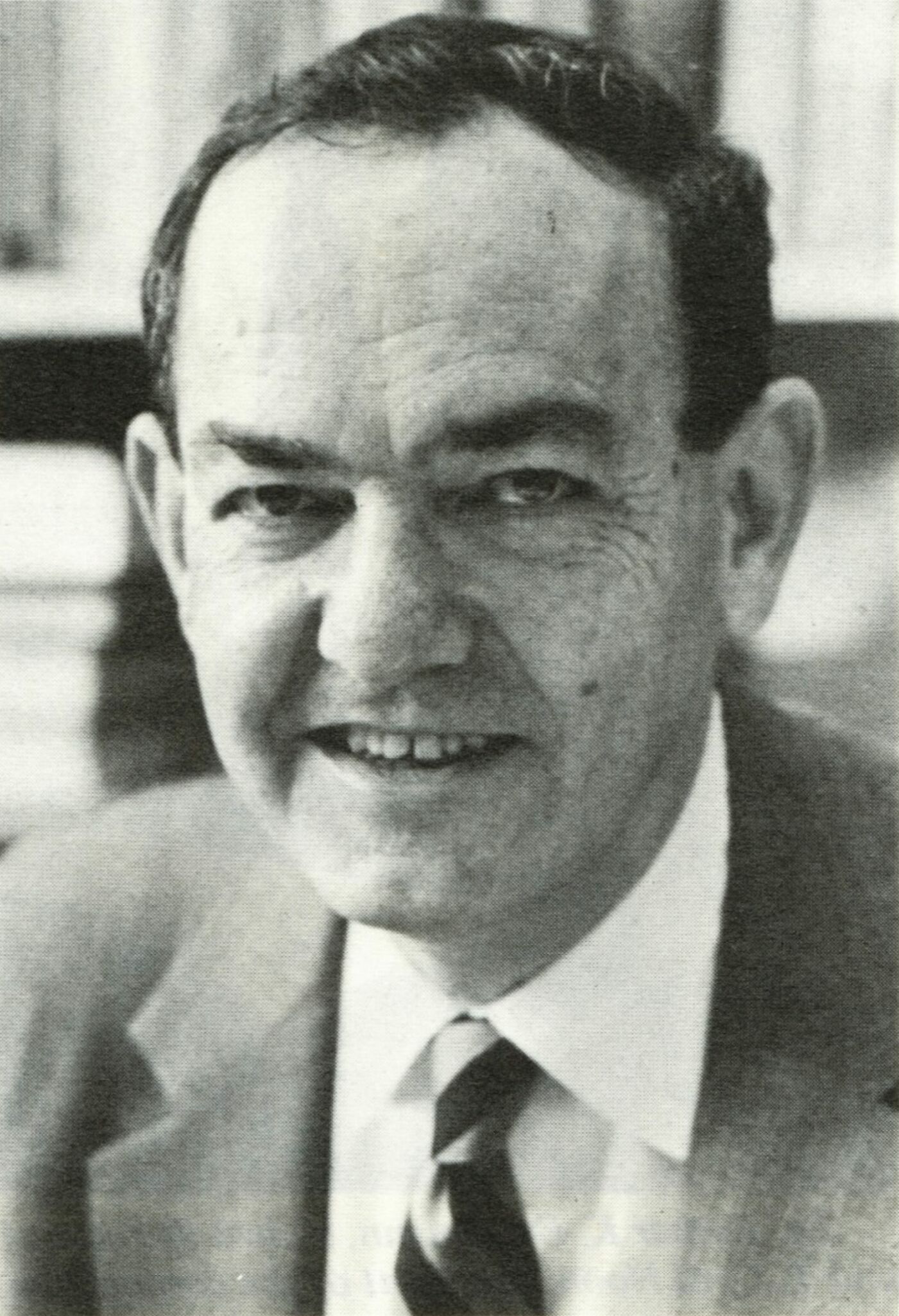
A Restless Political-Science PhD
In 1943 Herbert A. Simon, twenty-seven, took his doctorate at the University of Chicago. His field was political science; his dissertation was Administrative Behavior, a study of how people make decisions inside organisations. He had noticed something classical economics had quietly ignored. The real human being is not the textbook's "rational economic man." A real person has only so much time, so much computational power, so much patience. What a person can do is to find, under limited information and limited cognitive capacity, an answer that is "good enough" — not the answer that is "best."
Simon gave the phenomenon two names that would later make him famous: bounded rationality and satisficing (a portmanteau of satisfy and suffice). The insight looked plain. It would shake the entire foundation of the social sciences. Thirty-five years later, this idea would win him the Nobel Prize in Economics in 1978.
But in 1943 he was nowhere near that. He was only a young man with a restless curiosity, leaving political science for organisational behaviour, then for psychology, then for computers. He wanted to know exactly how the human brain computed.
Carnegie's Partner
In 1949 Simon joined the Carnegie Institute of Technology — later Carnegie Mellon University — to help build its Graduate School of Industrial Administration (GSIA). It was here that he met the partner who would change the course of his life: Allen Newell. They first met at the RAND Corporation in 1952. The young man, eleven years Simon's junior, spoke of information processing with light in his eyes. Simon later wrote: "We knew at once that we would be working together for a long time."
They worked together for forty years. They were never publicly known to quarrel. Such a thing is rare in academic life.
Logic Theorist: The First AI Program
Around Christmas 1955, Simon and Newell, with the RAND programmer Cliff Shaw, wrote a piece of code that startled the world. In early 1956 the program ran on RAND's JOHNNIAC computer. Its name was Logic Theorist (LT).
What could LT do? It could prove mathematical theorems — specifically, the propositional theorems of chapter two of Bertrand Russell and Alfred North Whitehead's Principia Mathematica. LT proved 38 of 52, and one of its proofs was simpler and more elegant than Russell's own. Simon mailed the result to Russell, who replied that he was "delighted to know that this dreary book, which had taken us ten years, can be continued in such a fashion."
LT was no brute-forcing machine. It used heuristic search: in a vast tree of possibilities it pruned by experience-grounded "selection rules," skipping the branches that obviously led nowhere. It was the first true AI program in history, and the first working model of cognitive science. In the summer of 1956 Simon and Newell brought LT to Dartmouth and demonstrated it for John McCarthy, Marvin Minsky, and the rest. Of all the groups at the workshop, theirs was the only one with a running program in hand.
It was also early in 1956, in a class, that Simon spoke the line that would be quoted again and again: "Over the Christmas holidays, Al Newell and I invented a thinking machine."
GPS, and "Within Twenty Years"
In 1957 Simon, Newell, and Shaw produced their second program: the General Problem Solver (GPS). LT had been bespoke to propositional logic. GPS aimed at something wilder: to abstract "solving any problem" into a single framework. Define a current state and a goal state; then, by means–ends analysis, narrow the gap between them, step by step. GPS was the first explicit declaration of the ambition for a general problem solver.
It was in this atmosphere of optimism that Simon, in 1957, made the prediction that would be quoted — and mocked — a thousand times:
"Within twenty years, machines will be capable of doing any work a man can do."
Twenty years later, in 1977, they could not. Forty years later, neither. Only in the 2020s did the sentence become less absurd, and only along a path Simon had not foreseen — large language models, not GPS. To have said it in 1957 was enough to make him the standard-bearer of "AI's over-optimists."
To be fair: Simon's optimism arose from a deep conviction. The human brain, he believed, was nothing more than a physical symbol system, and the laws of symbol systems could be reproduced by machines. He and Newell formalised this in their 1976 Turing Award lecture as the Physical Symbol System Hypothesis — the most contested and most rallying claim in the philosophy of AI.
Human Problem Solving
In 1972 the volume Simon and Newell had been building, Human Problem Solving, appeared. It ran to nine hundred pages. With mountains of psychological data — especially the think-aloud protocols of chess players, cryptanalysts, and geometry-problem solvers — they argued one claim: when a human solves a problem, what they do is, at bottom, symbol manipulation; and this manipulation can be precisely described as a program.
The book is one of the key texts in cognitive psychology's emergence from the shadow of behaviourism. It made mind once again an object of scientific study — not by philosophical speculation, but by the act of implementing it as an executable program.
Two Crowns: Turing and Nobel
In 1975 Simon and Newell jointly received the Turing Award for their "basic contributions to artificial intelligence, the psychology of human cognition, and list processing."
In 1978 Simon alone received the Nobel Prize in Economics for "his pioneering research into the decision-making process within economic organisations." The citation specifically named bounded rationality and satisficing.
He thus became one of the very few people in human history to hold both prizes. In the history of AI, he is the only one.
Late in life Simon did not slow. He worked on SOAR — Newell's grand engineering of a unified theory of cognition, the most ambitious symbolic-AI effort of the late period. He also helped quantify the very idea of expertise. Working with colleagues, he showed that chess masters were masters because their long-term memory held some 50,000 to 100,000 board-pattern chunks — the result of about a decade of focused training. Years later, K. Anders Ericsson would expand this finding into the theory of deliberate practice, popularised by best-selling authors and read around the world.
On 9 February 2001 Simon died in Pittsburgh, eighty-four years old. His bibliography reads like the catalogue of a research institute.
Selected Works
| Year | Work | Significance |
|---|---|---|
| 1947 | Administrative Behavior | Introduced bounded rationality; reshaped organisational decision research |
| 1956 | Logic Theorist (with Newell, Shaw) | The first AI program in history |
| 1957 | GPS (with Newell, Shaw) | First attempt at "general" problem solving |
| 1969 | The Sciences of the Artificial | Foundational text of design science and complex systems |
| 1972 | Human Problem Solving (with Newell) | Redefined cognitive psychology in symbol-processing terms |
| 1976 | "Computer Science as Empirical Inquiry" (with Newell) | Stated the Physical Symbol System Hypothesis |
Historian's Note
Historian's Note
Simon's strangeness lay in this: he never let himself be locked into a single discipline. He started in political science, passed through organisational behaviour, psychology, economics, and came to rest in computer science — and from computer science he turned back, making thinking into a runnable program, and sending the logic of that program back to economics to tell the classical economists that their imagined "rational man," who knew everything, had never existed. To stretch across the Turing Award and the Nobel Prize in Economics is, in the history of AI, unique. Yet he is also the standard-bearer of overreaching prophecy: "within twenty years machines will do any work a man can do" — quoted for seventy years, never quite vindicated, and yet now, along a route he never imagined, drawing closer. There is a paradox in the history of AI: "AI never arrives" and "AI is everywhere," and Simon is the embodiment of both. He set out to build a bridge between cognition, economics, and computation; today, the bridge has carried civilisation across.
Eyewitness Accounts
Call for contributions
If you knew Herbert A. Simon personally or have firsthand sources or recollections, please contribute on GitHub.
References
- Simon, H. A. (1947). Administrative Behavior: A Study of Decision-Making Processes in Administrative Organization. New York: Macmillan.
- Newell, A., Shaw, J. C., & Simon, H. A. (1957). "Empirical Explorations of the Logic Theory Machine." Proceedings of the Western Joint Computer Conference, 218–230.
- Newell, A., & Simon, H. A. (1972). Human Problem Solving. Englewood Cliffs, NJ: Prentice-Hall.
- Newell, A., & Simon, H. A. (1976). "Computer Science as Empirical Inquiry: Symbols and Search." Communications of the ACM, 19(3), 113–126.
- Simon, H. A. (1969). The Sciences of the Artificial. Cambridge, MA: MIT Press.
- Simon, H. A. (1991). Models of My Life. New York: Basic Books. (autobiography)
- Royal Swedish Academy of Sciences (1978). Press Release: The Sveriges Riksbank Prize in Economic Sciences in Memory of Alfred Nobel 1978.
- Crowther-Heyck, H. (2005). Herbert A. Simon: The Bounds of Reason in Modern America. Baltimore: Johns Hopkins University Press.
- Augier, M., & March, J. G. (Eds.) (2004). Models of a Man: Essays in Memory of Herbert A. Simon. Cambridge, MA: MIT Press.