Biography · Elon Musk
He is at once the prophet of AI doom and the starter of the AI arms race; he was Sam Altman (1985–)'s patron, and he is Sam Altman (1985–)'s plaintiff. AI history holds no figure more contradictory.
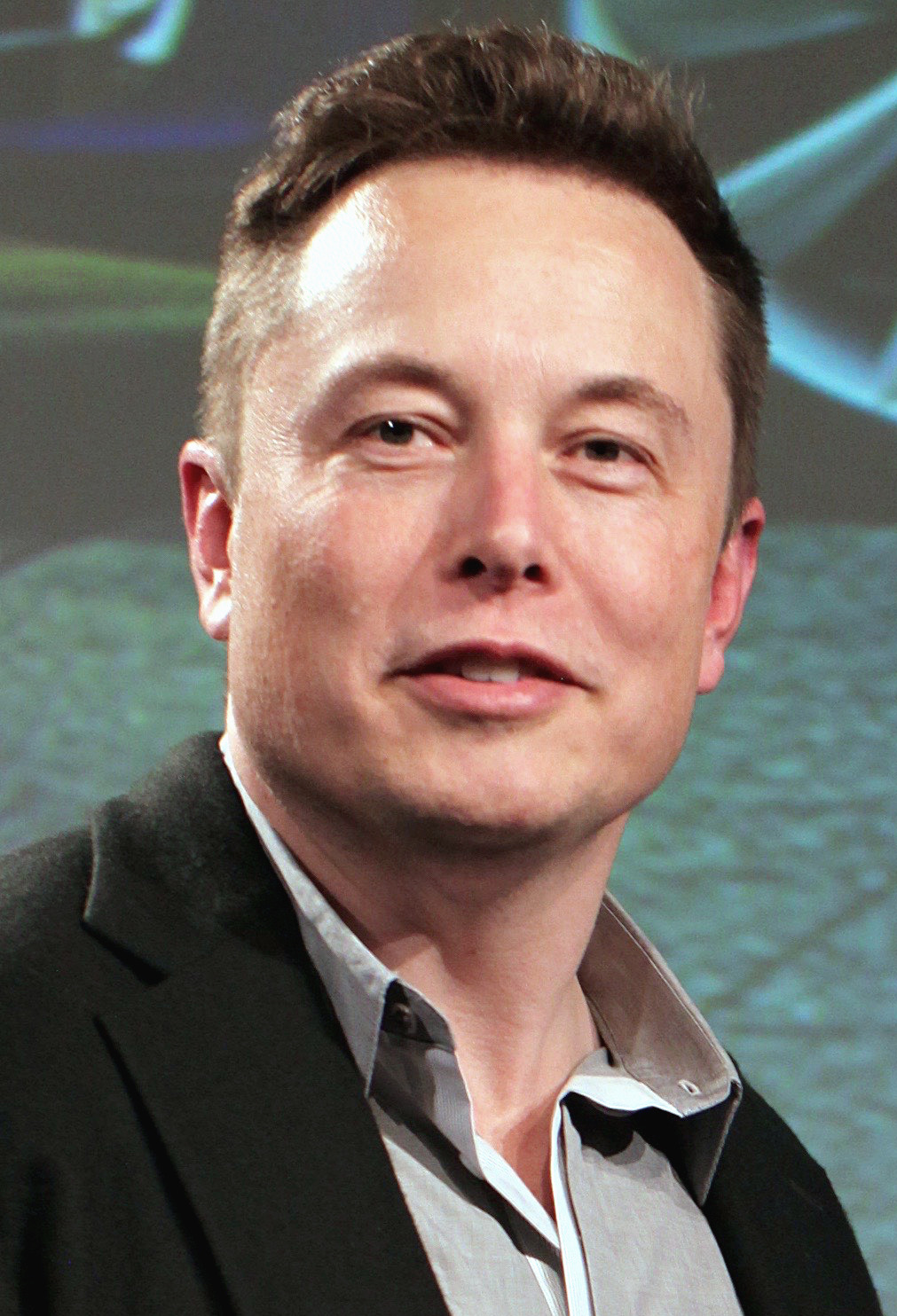
A Boy in Pretoria
Elon Musk (1971–) — full name Elon Reeve Musk — was born in Pretoria, South Africa, on 28 June 1971. His father Errol Musk was an engineer; his mother Maye Musk a model and dietitian. The parents divorced when he was eight, and he chose to live with his father — a decision he has spoken of in his biographies with deep regret. Years later he described his father as "the worst human being I have ever known."
In school Musk was bullied so badly that his nose was broken; at home he was locked into a cold war with his father. He buried himself in books — encyclopedias, Asimov, Heinlein, then The Hitchhiker's Guide to the Galaxy. At ten he used the money he had saved working odd jobs to buy a Commodore VIC-20 and taught himself BASIC. At twelve he wrote a space-shooter game called Blastar and sold the code to a magazine called PC and Office Technology for 500 US dollars — his first money from software.
At seventeen he had decided that South Africa was not his future. He left home, flew alone to Canada, and used his mother's Canadian citizenship to enter, working odd jobs in Toronto. In 1989 he entered Queen's University; in 1992 he transferred to the University of Pennsylvania, taking dual degrees in economics and physics. In 1995 he was admitted to a doctoral programme in applied physics and materials science at Stanford — and dropped out two days after enrolling. The internet had just been born; he was going to the Bay.
Zip2, X.com, and PayPal
In 1995, Musk and his brother Kimbal founded Zip2 in a small unheated office in Palo Alto — software for online city directories for newspapers. In February 1999 Compaq bought Zip2 for 307 million dollars; Musk, then 27, took home 22 million.
He did not pause. The same March he used over ten million dollars to start X.com, an internet bank. A year later X.com merged with Peter Thiel's Confinity, the focus shifting to its product PayPal. In July 2002 eBay acquired PayPal in a 1.5-billion-dollar stock deal; as the largest shareholder Musk took home about 165 million — his first great fortune.
But finance was never what he wanted. He used the money on three bets that would prove epic: founding SpaceX in 2002 to build rockets; investing 6.5 million dollars in Tesla in 2004 and becoming chairman; and joining his cousin in 2006 to invest in SolarCity for solar roofs.
"AI Is the Greatest Existential Threat to Humanity"
What truly turned Musk's eyes to AI was 2014. He read Nick Bostrom's Superintelligence; he met Demis Hassabis (1976–), the founder of DeepMind. That January Google had bought DeepMind for 500 million dollars; Musk himself was an early investor in DeepMind, and he watched a research lab he had backed swallowed by a search giant. He began to speak in public.
In October 2014, at the MIT AeroAstro Centennial Symposium, he uttered a line that has been repeated ever since: "I think we should be very careful about artificial intelligence. If I had to guess at what our biggest existential threat is, it's probably that. We are summoning the demon." The same year he wrote on Twitter that AI was more dangerous than nuclear weapons.
But his chosen path was not retreat. It was to step in himself and build a "right" version. In July 2015, at the Rosewood Sand Hill hotel in Palo Alto, he had dinner with Sam Altman (1985–), Ilya Sutskever (1986–), Greg Brockman, and several other young faces from the AI world. They agreed to build a non-profit AI lab as a check on Google's centralisation of AGI. On 11 December the same year, OpenAI was founded. Musk pledged up to a billion dollars in funding and became co-chair.
The Break: A Child Taken Away
The partnership did not hold. In February 2018 Musk suddenly announced his departure from the OpenAI board; the official reason was "to avoid conflicts of interest with Tesla's AI projects." From the emails that the later lawsuit made public, and from multiple reports, another truth emerged: he had wanted to fold OpenAI into Tesla and run it himself, and the other founders had refused; he had concluded that the team was being outpaced by Google in compute and talent and required a more radical structural overhaul. Rebuffed, he withdrew, and suspended most of his outstanding funding pledges.
He could not have known that the lab he was letting go was the AI engine that would define the next decade. In 2019 OpenAI established a for-profit subsidiary and signed a 10-billion-dollar deal with Microsoft; in 2020 GPT-3 erupted; at the end of 2022 ChatGPT swept the world. Each new headline struck him like a slap — the company he had funded, named, and helped envision was now being effectively run by what he called a "quarterly-results culture."
In late 2022 he complained on X that OpenAI had "betrayed its founding intent" and demanded to see its books, in vain. From that moment his attitude toward Altman turned from partner to adversary — and his next moves were unmistakably Muskian.
xAI and Memphis's 122-Day Miracle
On 9 March 2023 Musk quietly registered a company in Nevada called X.AI Corp. Two weeks earlier he had signed the open letter calling for a six-month pause on training models stronger than GPT-4 — a typically Muskian double-bet. On 12 July of the same year he formally announced xAI on X, with an ambitious mission: "to understand the true nature of the universe."
In November 2023 xAI released its first large model, Grok-1, the name lifted from Heinlein's Stranger in a Strange Land — a Martian word meaning "to understand by instinct, completely." Grok's selling point was not performance but its anti-woke posture: willing to swear, willing to joke, willing to comment on politics. Musk used it to attack what he called the "woke disease" of ChatGPT and positioned Grok as the AI of right-leaning users and the X platform's loyal fans.
But what truly impressed Silicon Valley was not Grok but the speed of xAI's data-centre construction. In July 2024 xAI took over a derelict Electrolux factory in Memphis, Tennessee. By September, 100,000 NVIDIA H100 GPUs were in production training — from contract signing through power refit, rack installation, network stand-up to first distributed training, the entire process took only 122 days. The supercomputer was named Colossus, in tribute to the wartime Bletchley Park machine that had broken Enigma. Jensen Huang (1963–) flew to Memphis in person and called it "engineering speed never seen before" — the industry norm is 18 to 24 months.
The speed rested not only on money but on Musk's ability to mobilise resources across his companies — SpaceX dispatched Starlink engineers to lay fibre, Tesla supplied Megapack energy storage to stabilise the grid, X platform operations engineers helped with system scheduling. This pulling of an entire empire's arms into a single rope is something pure-AI companies like OpenAI and Anthropic cannot replicate.
Old Accounts in Court
While xAI accelerated, so did the lawsuits.
In February 2024 Musk sued OpenAI, Sam Altman (1985–), and Greg Brockman in California state court, alleging breach of the founding non-profit intent. He withdrew the suit and refiled it that August in California's Northern District federal court, adding more defendants (including Microsoft) and new charges — fraud, RICO racketeering, unfair competition. In February 2025 he and a group of investors offered a 97.4-billion-dollar "unsolicited acquisition bid" for OpenAI, unanimously rejected by the board, but the aim was never the buyout itself: it was to anchor OpenAI's for-profit valuation.
The internal emails disclosed in the litigation became some of the most precious primary sources in AI start-up history. The most ironic stretch is the Musk of 2018 — pushing internally, in the most strident terms, for OpenAI's conversion to a for-profit company, demanding to take charge himself. Now, suing Sam Altman (1985–) for "betraying the non-profit intent," he has placed his 2018 self on the witness stand.
Empire Merger and the West Wing
In October 2022 Musk bought Twitter for 44 billion dollars, renaming it X in July 2023. On 28 March 2025 he announced on X that xAI was acquiring X — his AI company buying his social-media company in an all-stock deal, with xAI valued at 80 billion and X at 33 billion. The merged xAI Holdings was valued at about 113 billion; a fresh round of financing in September pushed it to 200 billion dollars.
In July 2024 Musk publicly endorsed Donald Trump and donated more than 200 million dollars through his America PAC, becoming one of the largest individual donors in a single election in U.S. political history. After Trump's second inauguration in January 2025, Musk became an adviser to the newly created DOGE (Department of Government Efficiency); on 24 March he formally took office, with a desk in the West Wing. The role bound xAI tightly to the federal government — and dropped him into conflict-of-interest hearings on both sides of the aisle. He was simultaneously a federal contractor (SpaceX, Tesla, xAI) and a government official tasked with cutting budgets.
By early 2026 Musk's empire spans rockets (SpaceX), electric cars and robots (Tesla's FSD, Optimus, Dojo), brain-machine interfaces (Neuralink), solar (SolarCity, now part of Tesla), social media (X), AI (xAI), and the West Wing — a single individual simultaneously the CEO of four trillion-dollar-class companies and a government official. No precedent in Silicon Valley history matches it.
Key Milestones
| Year | Event | Significance |
|---|---|---|
| 1995 | Founds Zip2 | First fortune of the internet age |
| 1999–2002 | Founds X.com → merges with Confinity into PayPal | eBay acquires for 1.5 billion dollars; capital base for everything that follows |
| 2002 | Founds SpaceX | Redefines private spaceflight |
| 2014 | MIT speech: "AI is the greatest existential threat" | First public framing of AI as existential risk |
| 2015 | Co-founds OpenAI | With Sam Altman (1985–), lights the fuse of the AGI age |
| 2018 | Leaves the OpenAI board | Loses the bid for control; goes from partner to bystander |
| 2022 | Buys Twitter for 44 billion dollars; renames it X the following year | Owns the largest real-time corpus of human conversation |
| 2023 | Founds xAI; releases Grok-1 | Re-enters the AI game |
| 2024 | Memphis Colossus comes online with 100,000 H100 GPUs in 122 days | Unprecedented speed of compute build-out |
| 2024–2025 | Sues OpenAI; offers 97.4-billion-dollar acquisition bid | Total court showdown with Sam Altman (1985–) |
| 2025 | xAI acquires X; DOGE adviser to Trump; valuation at 200 billion | Empire integration and a leap across power lines, in the same year |
Historian's Note
Historian's Note
To read Musk one must read his contradictions. In 2014 he warned that AI was "the greatest existential threat to humanity"; in 2015 he joined hands with Sam Altman (1985–) to found OpenAI to set guardrails; in 2018 he walked off, watching others turn that company into the most profitable AI empire on earth; in 2023 he stepped back into the ring, raised a 100,000-GPU cluster in 122 days, and re-entered the game with a single Grok; in 2024 he dragged his former ally into court, and his own 2018 emails into the evidence box. This double face — warning of the apocalypse and accelerating it at once — is no opportunism. It is Musk's true belief: whatever must be done must be done by me. This near-religious self-centredness is what enabled him to build SpaceX and Tesla, the kind of bets a rational person would never make; it is also what has driven every former partner of his eventually to a break. He sleeps six hours a night, runs four trillion-dollar-class companies and serves as adviser to a national government, posts dozens of times a day on X, and argues with the press in real time — that omnipresent presence is itself the mark he leaves on the age. Future readers need not rush to judge him hero or villain. Remember only one thing: without him, AI would not have been pushed before everyone so early and so violently; with him, AI is fated to know no quiet hour.
Eyewitness Accounts
Call for contributions
If you worked with Musk at Zip2, PayPal, SpaceX, Tesla, X, or xAI, or as an engineer on the Memphis Colossus project, please contribute on GitHub.
References
- Isaacson, Walter (2023). Elon Musk. Simon & Schuster.
- Vance, Ashlee (2015). Elon Musk: Tesla, SpaceX, and the Quest for a Fantastic Future. Ecco.
- Musk, E. (2014). MIT AeroAstro Centennial Symposium speech, October 24, 2014. (Source of the "summoning the demon" line.)
- xAI (2023). "Announcing xAI." Official launch announcement, July 12, 2023.
- xAI (2024). "Open Release of Grok-1." Apache 2.0 license, GitHub: xai-org/grok-1.
- Musk v. Altman et al., U.S. District Court, Northern District of California, Case No. 4:24-cv-04722 (filed August 2024).
- Reuters (2024). "Musk's xAI brings Memphis supercomputer Colossus online with 100,000 Nvidia GPUs." September 5, 2024.
- The Wall Street Journal (2025). "Musk's xAI Acquires X in $33 Billion Deal." March 28, 2025.
- Bloomberg (2024–2025). xAI funding coverage.
- The New York Times (2025). "Elon Musk's DOGE Office Sets Up Inside the White House." January 2025.
- Bostrom, Nick (2014). Superintelligence: Paths, Dangers, Strategies. Oxford University Press. (Cited by Musk as a source of his thinking.)